The Hidden Costs of MRO Inefficiency: Why Airlines and MROs Are Losing Millions

Vukašin, Founder of YourMRO.info
MRO effectiveness and digital transformation specialist.
The modern aviation industry is a finely tuned machine, but a single inefficient process can trigger a ripple effect of delays and financial losses. While both Maintenance, Repair, and Overhaul (MRO) organizations and airlines are constantly looking to reduce costs, a critical issue is often overlooked: a convoluted or ineffective MRO structure. This inefficiency acts as a hidden drain on revenue, resulting in millions of dollars lost each year for both parties.
A key contributor to this problem is a complex MRO structure with many small, disconnected departments. This departmental sprawl often slows down internal operations, as communication between teams can be delayed for days. The fragmentation of responsibilities, without a clear chain of command, means a simple request can require approval from multiple individuals, wasting valuable time and resources.
This article will break down the real costs of a sub-optimal MRO structure from the perspective of both the airline and the MRO, and outline the collaborative solutions that can turn these losses into profits.
The Cycle of MRO Inefficiency
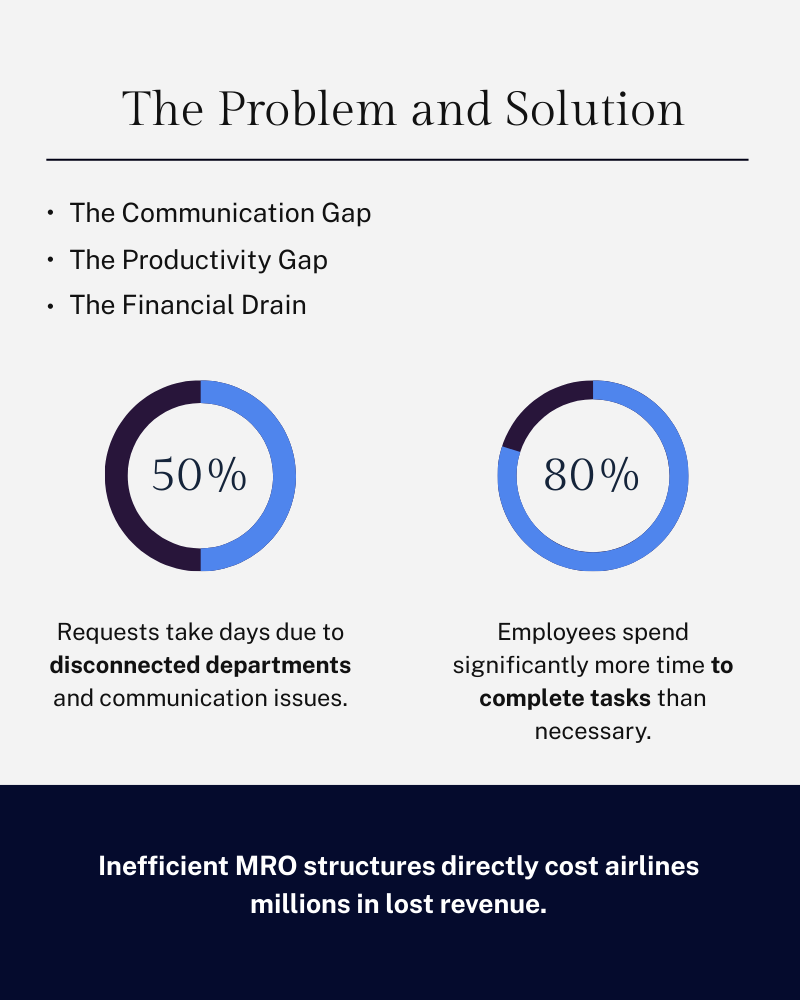
Inefficient MRO structures directly cost airlines millions in lost revenue.
The Airline’s Financial Drain: How an Inefficient MRO Structure Hurts Profitability
For an airline, an aircraft is only profitable when it is in the air. Any time it spends on the ground for maintenance is a direct hit to the bottom line. A disorganized or inefficient MRO structure turns this planned downtime into a financial disaster.
- Aircraft on Ground (AOG) Costs: This is the most visible and catastrophic cost. An unexpected maintenance issue or a delay in a scheduled check can ground an aircraft for hours or even days. The direct cost of an AOG can run into the tens of thousands of dollars per hour in lost revenue, not to mention the domino effect on flight schedules and crew rotations.
- Inflated Maintenance Costs: When an MRO's internal processes are inefficient, the airline ultimately pays the price. Delays in ordering parts, redundant quality checks, and technicians waiting for tools all contribute to the final bill. These costs are often passed on to the airline through higher labor rates and longer maintenance cycles.
- The Cost of Bureaucracy and Silos: An overly complicated MRO structure with poor communication directly impacts the airline. A request for a simple fix can get lost in a vast network of small, specialized departments, with each one delaying the process. This creates a time-consuming administrative burden that can extend maintenance periods and contribute to AOG events.
- Contractual and Regulatory Penalties: Maintenance is a highly regulated field. Missed deadlines, improperly documented work, or unapproved repairs can lead to stiff penalties from aviation authorities. A poorly structured MRO can expose an airline to unnecessary regulatory risk and financial penalties.
- Negative Impact on Customer Experience: The most insidious cost is the damage to a brand's reputation. Flight delays and cancellations caused by maintenance issues lead to a loss of customer trust, negative reviews, and a potential loss of future business. While difficult to quantify, this brand damage has a significant long-term impact on revenue.
The MRO’s Financial Drain: How Inefficiency Undermines Profitability
It's easy to assume an inefficient MRO simply passes on costs to its clients. However, a flawed internal structure is just as damaging to the MRO's own profitability and growth.
- Operational Bottlenecks and Wasted Labor: Manual, paper-based processes and a lack of real-time data integration create bottlenecks. Technicians spend more time on documentation than on actual maintenance. This wasted, non-productive labor time is a direct cost to the MRO and limits its ability to take on new projects.
- The Productivity Gap from Skill Erosion: In the last two decades, the overall knowledge of the workforce has decreased. As a result, an employee in the same position today takes approximately 30% more time to perform everyday tasks compared to a decade ago. While official training may qualify workers for a job, it rarely makes them truly efficient. This creates a significant productivity gap that costs MROs millions in wasted labor.
- Inventory and Supply Chain Waste: An ineffective MRO structure can lead to poor inventory management. Holding excess stock ties up valuable capital, while a lack of critical parts can lead to costly delays and damage client relationships. In an industry where margins are tight, every dollar spent on wasted inventory is a dollar of lost profit.
- Loss of Competitive Advantage: In an increasingly competitive market, efficiency and reliability are key differentiators. MROs that cannot provide transparent, on-time, and cost-effective services will lose business to more agile competitors. A poorly structured operation limits an MRO's scalability and ability to attract new clients.
- High Turnover and Training Costs: Technicians who are constantly frustrated by inefficient systems are more likely to seek employment elsewhere. The cost of recruiting and training new staff to replace them is a significant, and often overlooked, expense.
The Solution: A Collaborative Approach to MRO Effectiveness
The solution to these financial drains is not for one party to simply pressure the other. The most effective strategy is a collaborative one that uses modern systems and processes to create a more effective MRO structure for both sides.
- Digital Transformation and the Human Element: Implementing modern MRO software with real-time data integration is the first step. However, the biggest challenge to this is often **human resistance to change.** To overcome this, the transition must be smooth and incremental, with a focus on interactive, on-the-job training. This approach is more resource-intensive initially but far more effective in the long run, ensuring high adoption rates and lasting efficiency gains.
- Targeted On-the-Job Training: The key to closing the productivity gap is to focus on efficiency, not just eligibility. Active on-the-job training and mentorship programs can save airlines and MROs significant amounts of money by equipping staff with the practical skills and knowledge needed to perform tasks more efficiently and effectively.
- Human-Driven Predictive Maintenance: While data analytics are invaluable, some of the most powerful insights come from an experienced professional. A simple, inexpensive general inspection of the aircraft by a skilled Licensed Aircraft Engineer, often during a night stop, can provide a significant head start. Just by observing the aircraft, the engineer can predict most of the possible findings and provide a crucial advantage to the logistics and planning departments, turning potential delays into proactive preparation.
- Predictive Maintenance: Moving away from a reactive "fix-it-when-it-breaks" model to a proactive one using data analytics can significantly reduce unplanned downtime.
- Performance-Based Contracts: Structuring contracts to incentivize efficiency and collaboration can align the goals of both the airline and the MRO, turning a transactional relationship into a partnership.
Ready to transform your MRO structure? A well-defined strategy can turn these hidden costs into a competitive advantage.
Contact Vukašin today for a comprehensive consultation
